
When an ADA website lawsuit is served on your business in federal court, you have 21 days after service to file an answer or a motion, under Rule 12(a) of the Federal Rules of Civil Procedure. If you signed a waiver of service in time, you have 60 days from the date the request was sent. Call a lawyer the same day: missing the date can lead to a default.
What being served with an ADA website lawsuit means
Being served means the lawsuit has already been filed in court and the papers have been formally delivered to your business. It is different from a demand letter, which a firm sends before filing and which carries no court deadline. The demand letter guide covers that earlier stage.
Under Rule 4 of the Federal Rules of Civil Procedure, a summons must be served with a copy of the complaint. The summons must state the time within which the defendant must appear and defend, and warn that failing to do so will result in a default judgment for the relief the complaint demands. So the two documents together tell you the court, the case number, the plaintiff's lawyer and the deadline.
The complaint is a claim under Title III of the Americans with Disabilities Act, ADA, that your website denies a blind or disabled visitor full and equal use of your business. It usually lists the barriers the plaintiff says they met with a screen reader: images with no description, links with no text, form fields with no label.
These cases are common and concentrated. Suitcast counts 853 verified website accessibility filings in the 12 months to September 19, 2026, and 34 in the last 30 days, on its dataset page. The firms page shows that 78 plaintiff-side firms are named on federal website lawsuit dockets in those 12 months and the five most active account for 65% of them. Equal Access Law Group leads with 266 dockets, followed by Gottlieb & Associates with 147. Firms that file in volume cite the same failures from one complaint to the next, so the firm's page shows what its complaint against you likely lists.
The deadline to answer, and what changes it
The deadline is set by the rules, not by the plaintiff's lawyer, and it depends on how the papers reached you. Rule 12(a) gives a defendant 21 days after being served with the summons and complaint to serve an answer. A motion under Rule 12, such as a motion to dismiss, can be filed instead; if the court denies it, the answer is due 14 days after notice of that decision.
A plaintiff may first mail a request to waive formal service. Under Rule 4(d), the request must give you at least 30 days to return the waiver. If you return it in time, your answer is due 60 days after the request was sent. If you refuse without good cause, the court must make you pay the cost of formal service and the fees of any motion to collect it.
| Situation | Deadline to answer or move | Where it comes from |
|---|---|---|
| Summons and complaint served on you, federal court | 21 days after service | Rule 12(a)(1)(A)(i) |
| Waiver request received, not yet returned | At least 30 days to return it, as stated in the request | Rule 4(d)(1)(F) |
| Waiver signed and returned in time | 60 days after the request was sent | Rule 4(d)(3), Rule 12(a)(1)(A)(ii) |
| Rule 12 motion filed and denied | 14 days after notice of the court's decision | Rule 12(a)(4)(A) |
| Summons served in a California state court | 30 days after service | Code of Civil Procedure section 412.20(a)(3) |
Read the table from the top row that matches your papers. Count every day, weekends included; when the last day falls on a Saturday, Sunday or legal holiday, the period runs to the next working day (Rule 6(a)(1)). The court may extend the time for good cause (Rule 6(b)), which is a request your lawyer makes before the date, not after.
If nobody responds, Rule 55(a) says the clerk must enter the defendant's default once the failure to plead or defend is shown. That is the outcome the first week exists to prevent.
The first week, in order
Most of the first week is getting the right person the right papers, quickly. These steps are what owners in this position do; your lawyer decides the rest.
- Day one: write down how and when you were served. The date, the time, who handed over the papers and to whom. Put the summons and complaint somewhere safe and scan a copy.
- Day one: call a lawyer. A company cannot answer on its own: the Supreme Court wrote in Rowland v. California Men's Colony (1993) that for the better part of two centuries a corporation has been able to appear in federal court only through licensed counsel. Look for a lawyer who defends ADA website cases in the court named on the summons.
- Day one: read your business insurance policy for a notice requirement and tell the insurer in writing if the policy covers claims of this kind.
- Days one and two: find the docket. The case number on the summons finds it in PACER, the federal courts' records system, which charges ten cents a page, caps any document at three dollars and waives the bill for a quarter that stays at thirty dollars or less. CourtListener shows many dockets free. The plaintiff's firm's page on Suitcast shows how many cases it files and what its complaints cite.
- Days two and three: keep a record of the site as it is. Take dated screenshots of the pages the complaint names and save a scan report. Do not take the site down or delete pages without your lawyer: the complaint describes the site as it was, and your lawyer needs to see the same thing.
- Days three to seven: compare the complaint with the site. Check each barrier it lists against the page it names. Your lawyer decides how to respond; you supply the facts.
Do not call the plaintiff or the plaintiff's firm yourself, and do not reply to the complaint in writing. Everything goes through your lawyer.
What the complaint asks the court for
An ADA website complaint under Title III asks for two things above all: an order to make the website accessible, and the plaintiff's lawyer's fees. The statute's remedies section, 42 U.S.C. 12188, gives a private plaintiff the remedies of section 2000a-3(a), which is preventive relief such as an injunction, not money damages. Section 12205 lets the court award the prevailing party a reasonable attorney's fee, including litigation expenses and costs.
State law can add money. California's Unruh Civil Rights Act, Civil Code section 52(a), makes a business liable for actual damages and not less than $4,000 for each offense, plus attorney's fees. New York, California and Florida are the three busiest states for website accessibility filings on Suitcast's state pages, and each has its own laws, so a complaint's claims section should be read by a lawyer who practices in that state.
What the order would require is usually the same list of failures the complaint describes. Gottlieb & Associates' complaints, for example, most often cite pages with no title, images with no description and links with no text. Those are fixable in the site's editor, and fixing them is the one part of the case the owner controls directly.
Fixing the site while the case runs, with a dated record
Fixing what the complaint cites is worth doing early, with your lawyer's knowledge, because it is the relief the complaint asks for. What matters as much as the fix is proof of when it happened: a dated scan before, a dated scan after, and each later week showing the fix held.
Suitcast's free scan loads up to 5 pages of your public site in a real browser and lists each accessibility failure complaints cite, as the page's own HTML, with the page it is on and the fix in plain words. Each report carries its date. The check guide explains what the scan finds and what only a person can test, and the alt text guide covers the failure complaints list most, platform by platform.
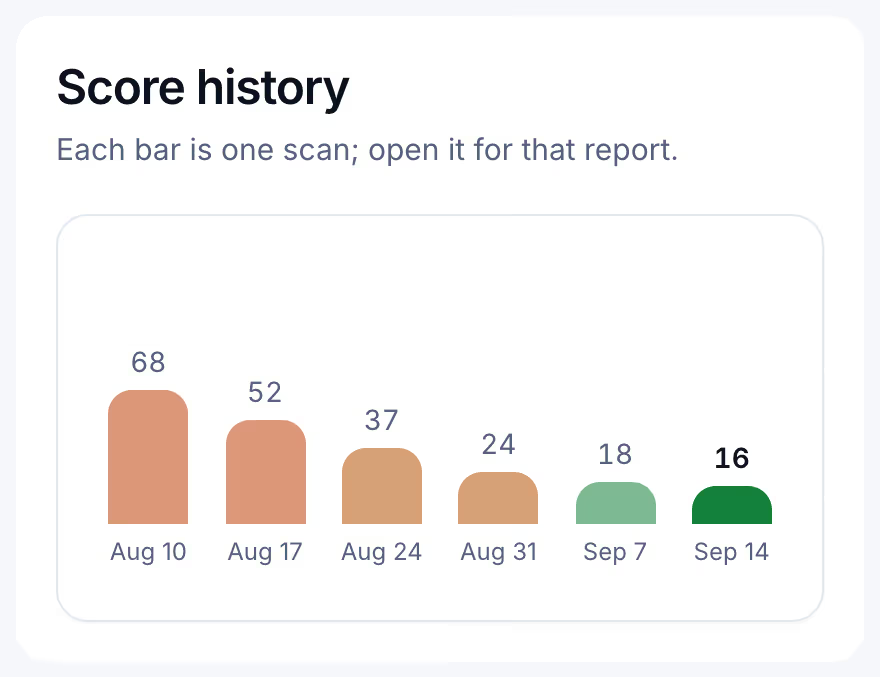
A free scan is one snapshot. Suitcast's Monitor plan re-scans the site, up to 100 pages, every week and keeps every report, with a PDF of each and a score history like the one below. Marking an issue fixed shows whether the next scan agrees, and the weekly email says what changed. It costs $39 a month or $390 a year; compare that with one hour of your lawyer's time. A restaurant in New York or a Shopify store in California can hand its lawyer the whole series instead of one screenshot. An agency whose client was served can cover five sites on Pro for $79 a month or $790 a year, with the agency name on each PDF. The pricing page has both plans.
Limitations
This guide describes federal court deadlines from the Federal Rules of Civil Procedure and one California state rule, as read on September 19, 2026. Local rules, a judge's order or a state court can set different times; the summons you received states the one that applies. Nothing here is legal advice, and no scan changes a deadline or the outcome of a case. The not legal advice page says what a score and a count mean.
An automated scan finds failures code can detect, on the pages it reads. It cannot tell whether alt text is meaningful or whether a checkout works by keyboard, and a clean result is not a finding that a site meets the ADA. The lawsuit counts are verified federal filings plus sourced state filings, so they are a floor, and state-court coverage is partial; the methodology page states every rule.
Suitcast identifies risk indicators. It is not legal advice and does not determine compliance.
Last updated September 19, 2026.