
The Unruh Civil Rights Act, California Civil Code section 51, makes every violation of the Americans with Disabilities Act, ADA, a violation of California law too, and section 52(a) sets at least $4,000 for each offense plus attorney's fees. That is why California website accessibility complaints add an Unruh claim to the federal one. Suitcast counts 139 such lawsuits attributed to California in the 12 months to September 22, 2026.
What the Unruh Act says about disability and websites
The Unruh Civil Rights Act is one short section of the California Civil Code. Section 51(b) says all persons in California, whatever their disability or medical condition, among other traits, are entitled to the full and equal accommodations, advantages, facilities, privileges or services in all business establishments of every kind whatsoever.
Section 51(f) is the sentence that turns a federal website case into a California one: a violation of a person's rights under the federal Americans with Disabilities Act of 1990 shall also constitute a violation of the Unruh Act. So when a complaint says a blind visitor could not use a site with a screen reader, and that this breaks Title III of the ADA, it can claim the same facts break California law.
Section 52(a) sets the price. A business that denies those rights is liable for each and every offense for the actual damages, and any amount a jury or court sets up to three times actual damages, but in no case less than $4,000, plus attorney's fees the court determines. Both sections were read on leginfo.legislature.ca.gov on September 22, 2026; section 51 was last amended effective January 1, 2025, and section 52 effective June 30, 2022.
The federal ADA alone does not pay a private plaintiff money. Its remedies section, 42 U.S.C. 12188, gives an injunction, and section 12205 lets the court award fees. The Unruh minimum is what California adds.
How an Unruh website claim is built, and what the courts held
An Unruh claim about a website can take one of two routes, and the California Court of Appeal set both out in Martinez v. Cot'n Wash, Inc., decided August 1, 2022 by the Second Appellate District. The first route is a violation of the ADA, through section 51(f). The second is denial of access through intentional discrimination.
The ADA route needs no proof of intent: the opinion cites the California Supreme Court's decision in Munson v. Del Taco (2009) for that. But it needs a real ADA violation, and Title III covers a "place of public accommodation". In Martinez, the court held that under current law it could not read that phrase as including retail websites without any connection to a physical space, so the claim against an online-only seller failed. The same opinion describes Thurston v. Midvale Corp. (2019), where a blind woman sued a restaurant over a website her screen reader could not use, and the appeal court, applying a test based on the site's connection to the restaurant, upheld judgment for her on the ADA theory.
The intent route is harder. The court held that the discriminatory effect of a site's design, even after the owner was told about the barriers and did not fix them, is not enough on its own to show intentional discrimination.
| Question | Federal ADA | Unruh through 51(f) | Unruh, no ADA claim |
|---|---|---|---|
| What must be shown | A barrier at a place of public accommodation | An ADA violation | Intentional discrimination |
| Intent needed | No | No (Munson, 2009) | Yes (Martinez, 2022) |
| Money for the plaintiff | None, an injunction | $4,000 minimum per offense | $4,000 minimum per offense |
| Attorney's fees | Yes | Yes | Yes |
| A restaurant's website | Covered (Thurston, 2019) | Covered (Thurston, 2019) | Needs intent |
| A retail site with no physical space | Not covered (Martinez, 2022) | Not covered (Martinez, 2022) | Needs intent |
The money row comes from section 52(a), which also allows actual damages up to three times; the fees row from 42 U.S.C. 12205 and section 52(a). Read the table by the kind of business you run. A site that serves a physical location, such as a restaurant, a clinic or a shop, is closer to the facts of Thurston; an online-only store is closer to Martinez. Courts in other districts, and federal courts, can reach different answers, so your lawyer reads the complaint against the cases that bind the court on the summons.
California website accessibility lawsuits, by the numbers
California is the busiest state for website lawsuits on Suitcast's state map, with 229 verified accessibility and tracking filings in the 12 months to September 22, 2026, ahead of New York with 206. Of those, 139 are website accessibility lawsuits and 90 are website tracking lawsuits under the California Invasion of Privacy Act, CIPA, which the CIPA letter guide covers. The California page shows 18 accessibility filings in the last 90 days and 5 in the last 30.
Five plaintiff firms lead California's count on that page. Equal Access Law Group is named on 62 filings against California businesses, followed by Gottlieb & Associates with 33, Bursor & Fisher with 14 (a tracking firm), Joseph & Norinsberg with 12 and Nye, Stirling, Hale, Miller & Sweet with 8. Nationally, Suitcast's dataset holds 851 website accessibility filings over the same 12 months.
A California business is not always sued in California. Equal Access Law Group's page shows California as its defendants' most common state, while 169 of its 266 dockets in the 12 months to September 22, 2026 sit in federal court in the Northern District of Illinois. The summons names the court, and the court decides which claims go forward.
These counts are a floor. Many Unruh claims are filed in California superior courts, and Suitcast's state-court coverage is partial: the counts hold federal filings from CourtListener plus sourced state filings, as the methodology page explains.
What California complaints cite, and where each fix lives
California complaints cite the same failures in a site's code as complaints anywhere, because the firms filing them work across the country. On Equal Access Law Group's page, its complaints most often cite clickable items that are not real links or buttons and images with no description, each in 261 complaints in the 12 months to September 22, 2026. Gottlieb & Associates' complaints most often cite pages with no title, images with no description and links with no text.
Each of these lives in a place the owner or the developer can open:
- Images with no description: the alt text field in the page or media editor. The alt text guide shows where it is on Shopify, WordPress, Squarespace and Wix.
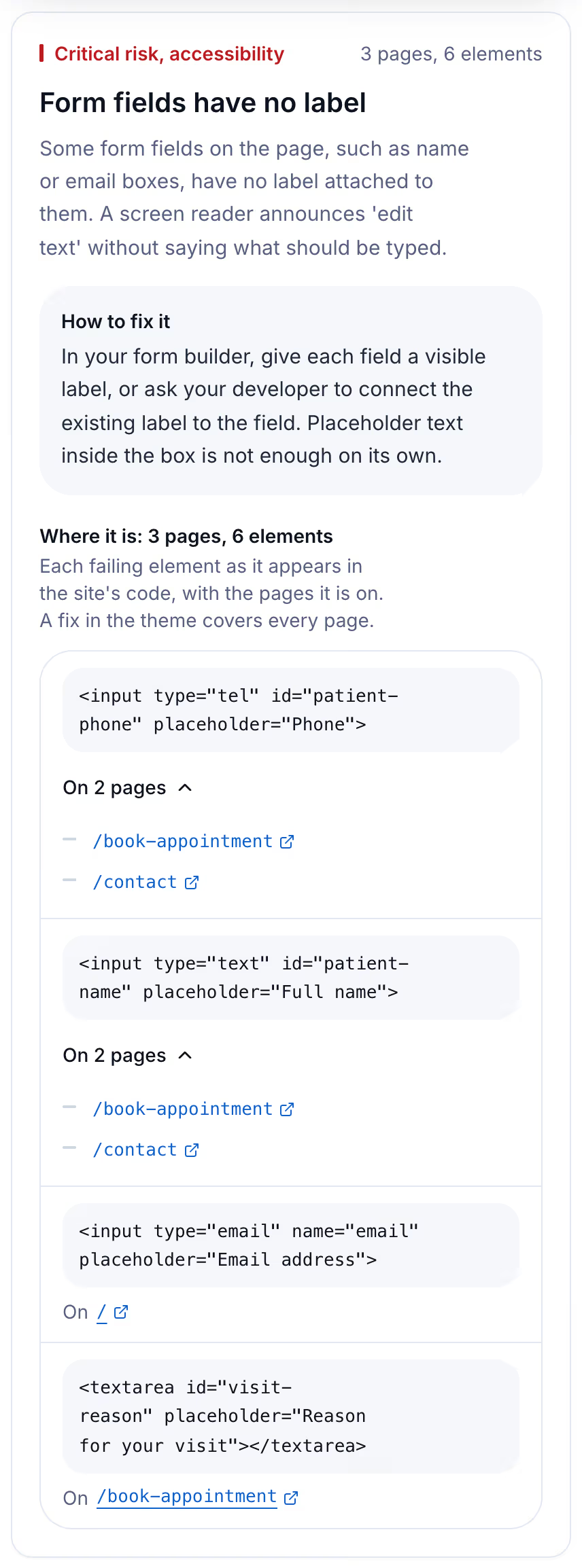
- Form fields with no label: the form builder's field settings, or the theme's form template. A placeholder inside the box is not a label.
- Links and buttons with no text: icon links in the header and footer, usually social icons, a cart or a menu button, fixed once in the theme.
- Pages with no title: the page's SEO or settings panel.
Suitcast's free scan checks the first 5 pages of a site for these failures in a real browser and names the failing element and the page it is on. The card below is one finding from such a report: a booking form whose fields have no labels, the kind of barrier a complaint describes when a screen reader announces "edit text" and nothing else.
California's construction rules and a website
California has a separate set of rules for accessibility claims about buildings, and owners who have dealt with a parking lot or a ramp claim often ask whether they apply to a website. They sit in Civil Code sections 55.51 to 55.57: a stay and early evaluation conference, an inspection by an access specialist (CASp), and, for small businesses, a presumption about certain minor violations fixed within 15 days.
Those rules apply to a "construction-related accessibility claim". Section 55.52 defines the standard behind such a claim as one requiring compliance with standards for making new construction and existing facilities accessible to persons with disabilities, naming the California Building Standards Code among others. The 15-day list in section 55.56 names items such as interior signs, parking signs and faded paint.
A website complaint is about code, not construction. Whether any part of those rules helps in a website case is a question for your lawyer; plan your fix as if none of them applies.
Keeping the fix in place, with a dated record
A fixed site can break again the next time a theme updates, a plugin adds a form or someone uploads a new image without alt text. What a California owner wants in hand, whether a letter has arrived or not, is proof of when each failure was found and when it was fixed.
A free scan is one dated snapshot of 5 pages. Suitcast's Monitor plan scans up to 100 pages every week, keeps every report with its PDF, shows whether an issue marked fixed stays fixed, and sends a weekly email with what changed on the site and which new filings match it by state, industry or issue. It costs $39 a month or $390 a year; set that against one hour of your lawyer's time. A dental practice in San Diego on WordPress or a Shopify store in Los Angeles can hand a lawyer a run of dated reports instead of one screenshot. An agency or a group with several locations covers five sites on Pro for $79 a month or $790 a year, with the agency's name on each PDF. The pricing page compares the plans.
Limitations
This guide quotes California Civil Code sections 51, 52 and 55.52 as read on leginfo.legislature.ca.gov on September 22, 2026, and two Court of Appeal decisions as described in the published Martinez opinion. Other courts, including federal courts in California, have ruled differently on websites, and the law can change. Nothing here is legal advice; the not legal advice page says what a score and a count mean.
An automated scan finds failures code can detect on the pages it reads. It cannot judge whether alt text is meaningful or whether a checkout works by keyboard, and a clean result does not mean a site meets the ADA or the Unruh Act. Suitcast's counts are verified federal filings plus sourced state filings; California superior court coverage is partial, so every California number here is a floor.
Suitcast identifies risk indicators. It is not legal advice and does not determine compliance.
Last updated September 22, 2026.