
Florida had 13 website accessibility filings in the 30 days to September 25, 2026, more than any other state on Suitcast's map, and 133 over 12 months. A Florida website lawsuit is a federal claim under the Americans with Disabilities Act, ADA, brought by a small group of firms, three of the five busiest based in Florida, and it cites the same few failures in a site's code.
What a Florida website accessibility lawsuit asks for
A Florida website accessibility lawsuit is a claim under Title III of the Americans with Disabilities Act, the part of the federal law that covers businesses open to the public. The plaintiff, often a person who is blind and uses a screen reader, says the site could not be used and asks a federal court to order it fixed.
The remedy is set by statute. 42 U.S.C. 12188(a)(1) gives a private plaintiff the remedies in section 2000a-3(a), which is "preventive relief, including an application for a permanent or temporary injunction". Section 12188(a)(2) adds that an injunction can require "the provision of an auxiliary aid or service". There is no line for damages. What makes the claim worth filing is section 12205: the court may allow the prevailing party "a reasonable attorney's fee, including litigation expenses, and costs". So the money at stake in a Title III website case is the plaintiff's fees and costs, plus the cost of the fix.
That makes Florida different from California and New York, where state laws add money for the plaintiff; the Unruh Act guide and the New York guide explain those. The Florida federal complaints Suitcast has read ask for an injunction and attorney's fees under the ADA, and those that name a version of the Web Content Accessibility Guidelines, WCAG, cite 2.1 or 2.2.
The deadline is federal too. Rule 12(a) of the Federal Rules of Civil Procedure gives a defendant 21 days after being served to answer, or 60 days after a waiver request was sent. The first 21 days guide sets out that week in order. Suitcast's free scan lists the failures these complaints describe, page by page, before anyone files.
Florida website lawsuits, by the numbers
Florida has more website accessibility filings than any other state over the last 30 days. On the Florida page, as of September 25, 2026, Suitcast counts 13 website accessibility filings in the last 30 days, 25 in the last 90 days and 133 in the last 12 months. Over the same 30 days New York had 10 and California 6. Over 12 months Florida's 133 is second only to New York's 150. Nationally, the dataset holds 831 website accessibility filings in those 12 months, so Florida is about one in six.
A small group of firms files them. On the Florida page, the most active firms over 12 months are Equal Access Law Group with 22 Florida filings, the Law Office of Pelayo Duran with 16, Brasil Brasil with 15, Gottlieb & Associates with 12 and Mendez Law Offices with 10. Three of the five are based in Florida. Equal Access Law Group, the busiest firm nationally, has filed nothing since June 3, 2026; the newest Florida filings on the page come from Brasil Brasil, Mendez Law Offices, Adams & Associates and Gottlieb & Associates.
Where a case is filed depends on the firm. Brasil Brasil's 15 filings all sit in the Southern District of Florida, which includes Miami. The Law Office of Pelayo Duran filed 10 in the Middle District, which includes Tampa and Orlando, and 6 in the Southern District. Gottlieb & Associates files in the Southern District of New York, so a Florida business can be sued in Manhattan over its website.
The businesses on the other side are ordinary. In Florida over 12 months, the industries with the most filings are restaurants and bars with 8, entertainment and media, food and beverage brands, and retail and online stores with 4 each, and salons, spas and beauty and jewelry stores with 3 each. The state page also lists repeat plaintiffs, one of whom is named on 15 filings.
The Eleventh Circuit vacated its 2021 website ruling
Florida's federal courts sit in the Eleventh Circuit, and that court's best-known website opinion was vacated by the panel that wrote it. In Gil v. Winn-Dixie Stores, Inc., a blind customer said he could not use the grocery chain's website, which offered prescription refills and digital coupons for its stores. After a bench trial in the Southern District of Florida in 2017, the district court found the website violated the ADA.
On April 7, 2021, a divided Eleventh Circuit panel vacated that judgment, reported at 993 F.3d 1266. The majority held that public accommodations under Title III "are limited to actual, physical places", that websites are not a place of public accommodation, and that this website was not an intangible barrier to the physical stores. Judge Jill Pryor dissented.
On December 28, 2021, the same panel granted the plaintiff's petition for rehearing. Because the injunction had expired while the appeal was pending, it held the appeal moot, vacated its own opinion and the judgment, and sent the case back to be dismissed, reported at 21 F.4th 775. Both orders were read on CourtListener on September 25, 2026.
So both the 2017 judgment and the 2021 opinion were vacated, and neither stands as a ruling of the court. The filing counts above show what followed in practice: plaintiffs kept filing website cases in Florida's federal districts, 133 of them attributed to the state in the last 12 months alone.
What Florida's own statutes say about websites
Two Florida statutes are worth knowing about. Neither mentions websites.
Florida Statutes section 553.5141, enacted in 2017, lets the owner of a place of public accommodation file a certification of conformity or a remediation plan with the Department of Business and Professional Regulation. Subsection (5) says that in any Florida action alleging a Title III violation, a court must consider a plan or certification filed before the complaint when it decides whether the complaint was filed in good faith and whether the plaintiff is entitled to attorney fees and costs. The section defines a facility as buildings, structures, sites, equipment and other real or personal property, and its qualified experts are mostly licensed engineers, contractors, building inspectors and architects, plus anyone whose Title III remediation plan or testimony a federal court has accepted. Whether a website plan filed there counts is a question for a Florida lawyer.
The Florida Civil Rights Act, section 760.08, entitles all persons to the full and equal enjoyment of any place of public accommodation without discrimination on the ground of handicap. Section 760.02(11) defines public accommodations by listing lodging, restaurants and other places selling food for consumption on the premises, gasoline stations, and theaters, arenas and other places of exhibition or entertainment. Both sections were read on flsenate.gov on September 25, 2026.
What Florida complaints cite, and where each fix lives
The complaints describe a site's code, and Suitcast's firm pages list what each firm's complaints cite. Images with no description sit at or near the top of the list for all three Florida-based firms in the top five. Brasil Brasil's page, as of September 25, 2026, lists clickable items that are not real links or buttons, images with no description and keyboard order forced out of sequence, each in 12 of its complaints. The Law Office of Pelayo Duran's page lists images with no description in 6 complaints and the two keyboard failures in 5 each.
| What the complaint cites | What it means for a visitor | Where the fix lives |
|---|---|---|
| Images have no description | A screen reader says "image" and nothing else | The alt text field beside each image, in the page or product editor |
| Links have no text | Icon links, such as social icons or a cart, are read as "link" | The theme's header and footer, fixed once for every page |
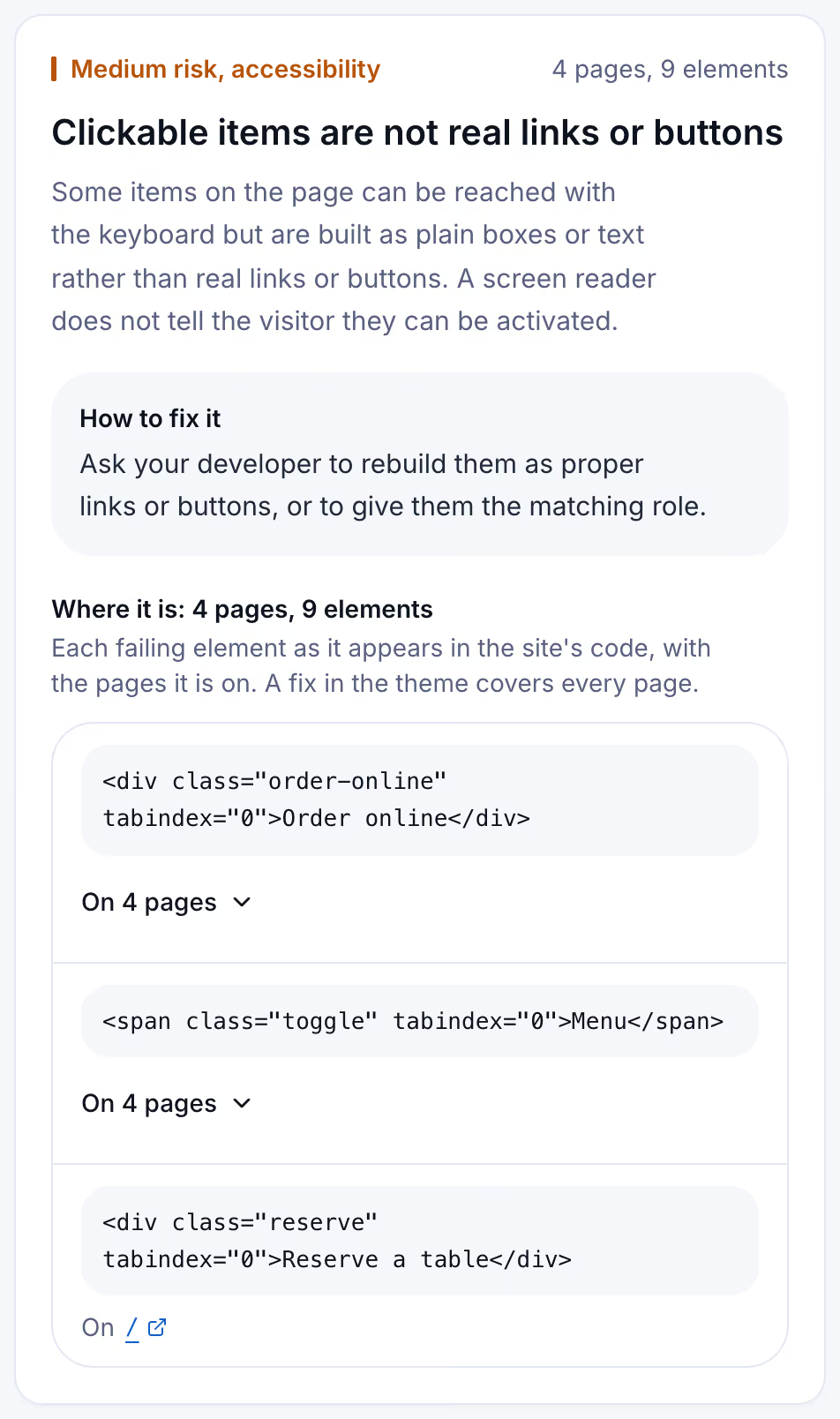
| Clickable items are not real links or buttons | A menu or an "Order online" box is built as plain text, so a screen reader never says it can be pressed | The theme or template code, usually a developer's job |
| Keyboard order forced out of sequence | The Tab key jumps around the page instead of moving top to bottom | The theme code: positive tabindex values removed |
| Text is hard to read against its background | Low contrast between text and background | The theme's colors, in the site styles panel |
Read the table from the top. The first two rows are fixes an owner makes in the editor in an afternoon; the alt text guide shows where the field lives on Shopify, WordPress, Squarespace and Wix. The keyboard rows sit in the theme's code, which is why they survive a content cleanup and why a Florida restaurant on a template site can have them without knowing.
The card below is a keyboard finding from a Suitcast report on a reserved example address: the failing HTML, and every page it was found on.
Keeping a Florida site fixed, with a dated record
A site that passes today breaks again the next time a theme updates, a menu is rebuilt or a new product photo goes up without alt text. What an owner wants, whether a complaint has arrived or not, is a record of when each failure was found and when it was fixed.
A free scan is one dated snapshot of 5 pages. Suitcast's Monitor plan scans up to 100 pages every week, keeps every report with its PDF, shows whether an issue marked as fixed stays fixed, and sends a weekly email with what changed on the site and which new filings match it by state, industry or issue. It costs $39 a month or $390 a year, less than one hour of a Florida litigator's time. A restaurant in Orlando on Wix or a boutique in Miami on Shopify can hand a lawyer a run of dated reports instead of one screenshot. An agency or a group with several locations covers five sites on Pro for $79 a month or $790 a year, with the agency's name on each PDF. The pricing page compares the plans.
Limitations
This guide quotes 42 U.S.C. 12188, 12205 and 2000a-3, Federal Rule of Civil Procedure 12, Florida Statutes sections 553.5141, 760.02 and 760.08, and the Eleventh Circuit's two orders in Gil v. Winn-Dixie, all read on September 25, 2026. Courts disagree on whether and how Title III reaches a website, and the law can change. Nothing here is legal advice; the not legal advice page says what a score and a count mean.
An automated scan finds failures that code can detect on the pages it reads. It cannot judge whether alt text is meaningful, whether a checkout works by keyboard from start to finish or whether a video caption is accurate, and a clean result does not mean a site meets the ADA. Suitcast's counts hold verified federal filings plus state filings with a public source, so every Florida number here is a floor; the methodology page explains how a case is attributed to a state.
Suitcast identifies risk indicators. It is not legal advice and does not determine compliance.
Last updated September 25, 2026.