
A website accessibility lawsuit filed in New York usually cites three laws at once: the federal Americans with Disabilities Act, ADA, the New York State Human Rights Law and the New York City Human Rights Law. The two New York laws pay the plaintiff money, which the ADA does not. Suitcast counts 151 website accessibility filings attributed to New York in the 12 months to September 23, 2026.
What the New York State Human Rights Law requires of a website
The New York State Human Rights Law sits in article 15 of the Executive Law. Section 296(2)(a) makes it an unlawful discriminatory practice for the owner, manager or agent of a place of public accommodation to deny a person, because of disability, any of the accommodations, advantages, facilities or privileges of that place.
Two more sentences decide most website arguments. Section 292(9) defines a place of public accommodation to include "wholesale and retail stores and establishments dealing with goods or services of any kind". Section 296(2)(c)(ii) says a discriminatory practice includes a refusal to take the steps needed so that no person with a disability is denied services because auxiliary aids and services are absent, unless the owner shows a fundamental alteration or an undue burden. A screen reader is how a blind visitor reads a page, so the argument in a complaint is that the site withholds a service the business offers everyone else.
Section 300 tells a court how to read all of it: the article is construed liberally for its remedial purposes, and exceptions are construed narrowly. That sentence was added in 2019.
The money comes from two places. Section 297(9) gives a person a cause of action in court for damages, and section 297(10) lets the court award reasonable attorney's fees to a prevailing party. Civil Rights Law section 40-d adds a penalty of not less than one hundred and not more than five hundred dollars for each violation, recovered by the person aggrieved, with notice to the Attorney General. All of these sections were read on nysenate.gov on September 23, 2026.
Section 297(9) also carries a trap for the business and the plaintiff alike: a person who files a complaint with the Division of Human Rights gives up the court action on the same grievance, unless the Division dismisses it for administrative convenience or annuls the election of remedies. Where a claim lands changes what it can win. Suitcast's free scan records the failures these complaints describe, page by page, before anyone files anything.
How the New York City Human Rights Law goes further
The New York City Human Rights Law is title 8, chapter 1 of the Administrative Code, published in full by the City Commission on Human Rights. Section 8-102 defines a "place or provider of public accommodation" as including "providers, whether licensed or unlicensed, of goods, services, facilities, accommodations, advantages or privileges of any kind". Nothing in that sentence requires a physical place, which is why a complaint against a site with no storefront leans on the city law.
Section 8-107(4)(a) makes it unlawful for such a provider to deny a person, because of disability, the full and equal enjoyment of its accommodations, advantages, services, facilities or privileges. Section 8-107(15)(a) adds a duty to make a reasonable accommodation so a person with a disability can enjoy the right in question, where the disability is known or should have been known.
Section 8-130 says the city law is construed liberally for its "uniquely broad and remedial purposes", independently of how comparable state and federal wording has been read. Section 8-502 sets the remedy: a civil action for damages, including punitive damages, and injunctive relief; three years to bring it, under subdivision (d); and, under subdivision (g), attorney's fees, expert fees and costs to the prevailing party at Manhattan hourly rates.
| Question | Federal ADA | State Human Rights Law | City Human Rights Law |
|---|---|---|---|
| Where it lives | 42 U.S.C. 12181 and following | Executive Law 292, 296, 297 | Administrative Code 8-102, 8-107, 8-502 |
| Who it covers | A place of public accommodation | A place of public accommodation, defined to include establishments dealing with goods or services of any kind | A place or provider of goods or services of any kind |
| Money for the plaintiff | None, an injunction | Damages under 297(9), plus a penalty per violation under Civil Rights Law 40-d | Damages, including punitive damages, under 8-502(a) |
| Attorney's fees | Yes, 42 U.S.C. 12205 | At the court's discretion, 297(10) | At the court's discretion, 8-502(g) |
| How it is read | Federal case law | Liberally, Executive Law 300 | Liberally and independently, 8-130 |
| Time limit | No single federal limit | Three years, CPLR 214(2) in court and Executive Law 297(5) at the Division | Three years, 8-502(d) |
Read the table down the money row. The ADA alone pays a plaintiff's lawyer, not the plaintiff, so a New York complaint adds the state and city claims to ask for damages. That is a legal question for your lawyer, not a setting you can change, and the one thing you can change is the site itself.
A federal court in Brooklyn let a website claim proceed under all three laws
In Andrews v. Blick Art Materials, LLC, decided August 1, 2017 in the Eastern District of New York and reported at 268 F. Supp. 3d 381, a blind plaintiff said he could not use dickblick.com with a screen reader. The retailer moved to dismiss. Judge Jack B. Weinstein denied the motion on the ADA claim, the state claim and the city claim.
On the state law, the opinion calls the website question an issue of first impression and works through New York's own precedent. It quotes the Court of Appeals in United States Power Squadrons v. State Human Rights Appeal Board (1983) for the rule that "place" in the statute is "a term of convenience, not of limitation", and notes that the statute already reaches establishments that supply services at no fixed place, such as mail order and home delivery. On the city law, it applies Williams v. New York City Housing Authority (2009) and the one-way ratchet in Loeffler v. Staten Island University Hospital (2009): state and federal readings are a floor the city law cannot fall below.
One district judge's order is not the last word. The same opinion sets out how the federal circuits have split on whether a place of public accommodation must be physical, and courts inside New York have since taken different views of that question. What it does show is the shape of the argument a New York complaint makes, and how little of it turns on the size of the business.
New York website lawsuits, by the numbers
New York is second among the states on Suitcast's state map, with 206 verified filings in the 12 months to September 23, 2026, behind California's 225. Of New York's total, 151 are website accessibility filings and 55 are website tracking filings under California's privacy law, brought against New York businesses. The New York page shows 25 accessibility filings in the last 90 days and 7 in the last 30. Nationally, Suitcast's dataset holds 843 website accessibility filings over the same 12 months.
Four firms account for most of it. Gottlieb & Associates, based in New York, is named on 39 filings against New York businesses, followed by Equal Access Law Group with 29, Joseph & Norinsberg with 27 and Nye, Stirling, Hale, Miller & Sweet with 8. Bursor & Fisher, a tracking firm, accounts for 10.
Volume is the pattern, not the exception. Gottlieb & Associates is named on 148 federal dockets in the 12 months to September 23, 2026, 62 of them in the last 90 days, and 147 of those filings sit in the Southern District of New York. Joseph & Norinsberg is named on 63, with 23 in the last 90 days. The businesses on the other side are ordinary: in New York over those 12 months, the industries with the most filings are entertainment and media with 8, salons, spas and beauty with 6, medical and health providers with 5, and clothing brands and restaurants with 4 each.
These counts are a floor. Suitcast verifies federal filings from CourtListener plus state filings with a public source, and state-court coverage is partial, as the methodology page explains. New York Supreme Court filings under the state and city laws are not all on record here.
What New York complaints cite, and where each fix lives
The complaints describe a site's code, and the same few failures appear again and again. On Gottlieb & Associates' firm page, the issues its complaints most often cite are the page having no title, images with no description and links with no text, each named in 136 complaints in the 12 months to September 23, 2026.
Each one has an owner-level fix:
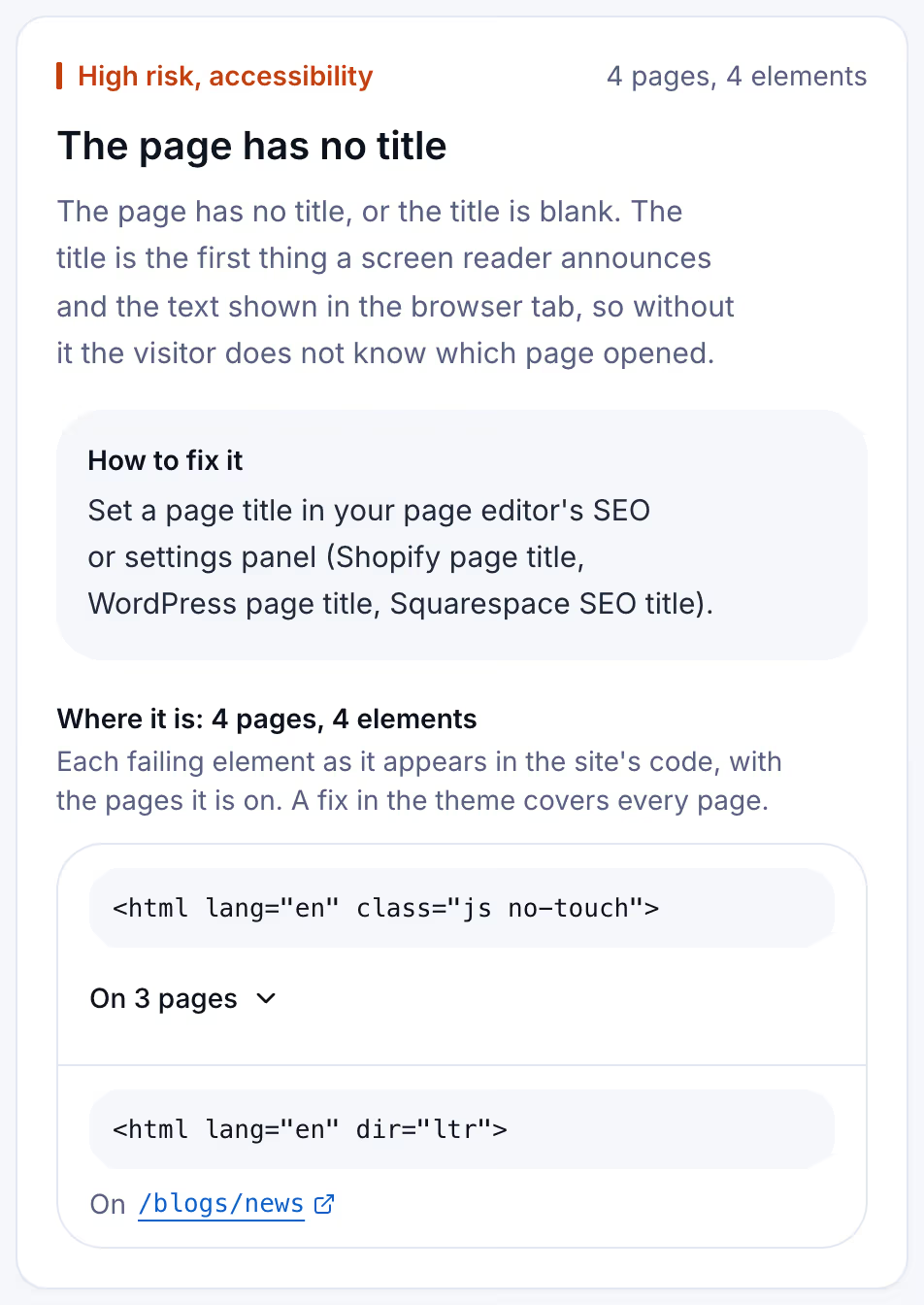
- The page has no title: the SEO or page settings panel in Shopify, WordPress or Squarespace. A screen reader announces the title first, so a blank one leaves the visitor with nothing.
- Images have no description: the alt text field beside each image. The alt text guide shows where it lives on four platforms.
- Links have no text: icon links in the header and footer, usually social icons or a cart, fixed once in the theme.
- Form fields have no label: the form builder's field settings. A placeholder inside the box is not a label.
The card below is one such finding from a Suitcast report, on a reserved example address: the page title failure, with the failing HTML and every page it was found on.
Keeping a New York site fixed, with a dated record
A site that passes today breaks again the next time a theme updates, a plugin adds a form, or someone uploads a product photo without alt text. What an owner wants, whether a letter has arrived or not, is a record of when each failure was found and when it was fixed.
A free scan is one dated snapshot of 5 pages. Suitcast's Monitor plan scans up to 100 pages every week, keeps every report with its PDF, shows whether an issue marked as fixed stays fixed, and sends a weekly email with what changed on the site and which new filings match it by state, industry or issue. It costs $39 a month or $390 a year, which is less than an hour of a New York litigator's time. A dental practice in Brooklyn on WordPress or a boutique in Manhattan on Shopify can hand a lawyer a run of dated reports instead of one screenshot. An agency or a group with several locations covers five sites on Pro for $79 a month or $790 a year, with the agency's name on each PDF. The pricing page compares the plans.
Limitations
This guide quotes New York Executive Law sections 292, 296, 297 and 300, Civil Rights Law section 40-d and New York City Administrative Code sections 8-102, 8-107, 8-130 and 8-502 as published on nysenate.gov and nyc.gov and read on September 23, 2026, and one 2017 federal district court opinion. Courts in New York have reached different answers on whether a site with no physical location is covered, and the law can change. Nothing here is legal advice; the not legal advice page says what a score and a count mean.
An automated scan finds failures that code can detect on the pages it reads. It cannot judge whether alt text is meaningful, whether a checkout works by keyboard or whether a video caption is accurate, and a clean result does not mean a site meets the ADA or either New York law. Suitcast's counts hold verified federal filings plus state filings with a public source, so every New York number here is a floor, and cases filed in New York Supreme Court are largely not in it.
Suitcast identifies risk indicators. It is not legal advice and does not determine compliance.
Last updated September 23, 2026.